


AI for Humanity
Grow with Humanism in the AI Era
AI as a Force for Human Empowerment and Dignity
By: Luis Alan Ríos Guzmán · Published: July 2026 · Updated: October 2026
On This Page
You can read AI for Humanity from beginning to end, or explore the sections that speak most directly to your interests. The ideas build on one another, but each section can also stand on its own.
Whether you’re curious about the future of AI, human-centered technology, responsible innovation, or how we can strengthen our uniquely human capabilities, I encourage you to explore at your leisure.
The Human + AI Synergy Loop
A Human-Centered Model for Decision-Making, Responsible Innovation & Human-AI Synergy
Please notice how AI is an optional part of the loop.
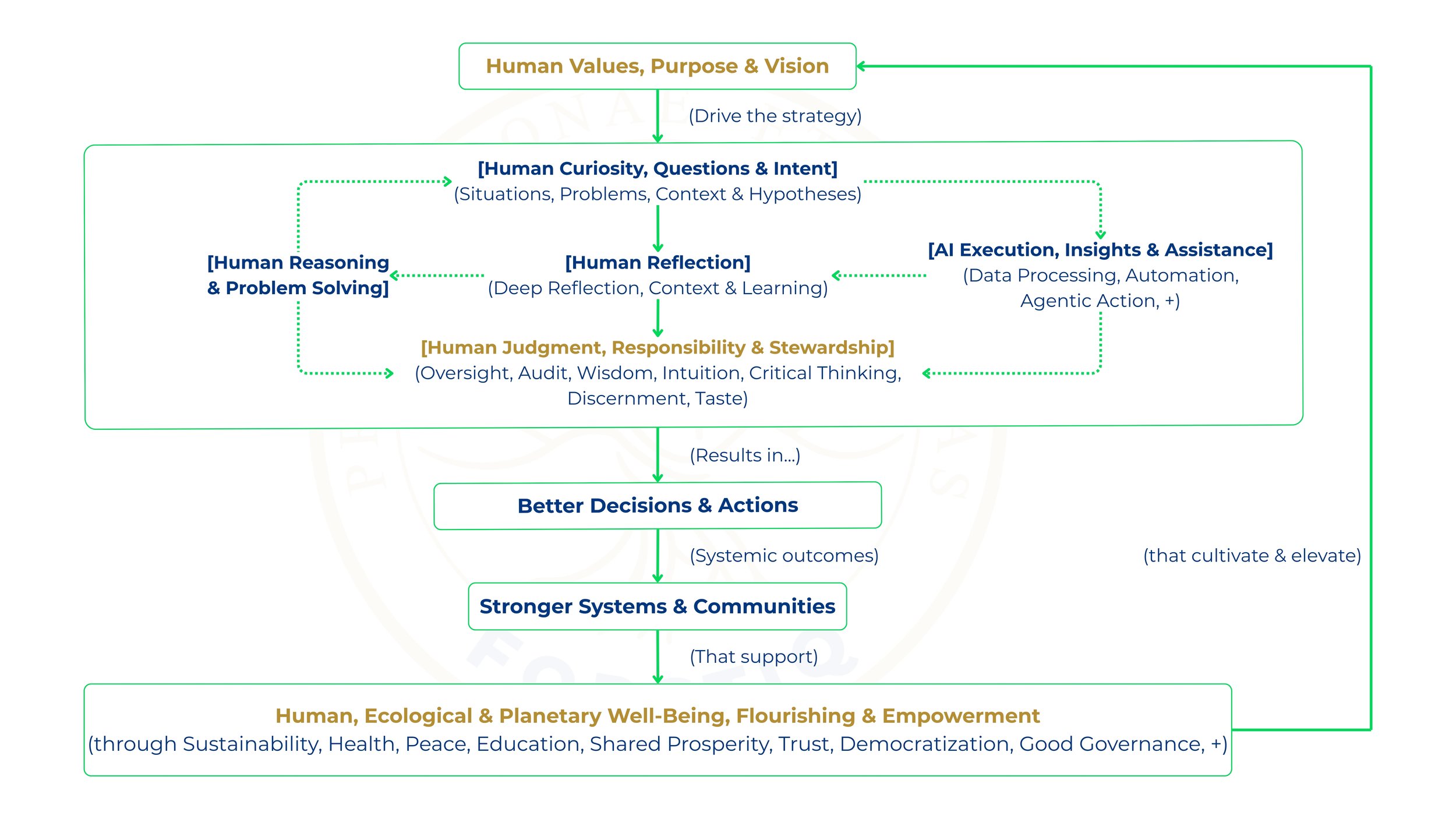
At the heart of AI for Humanity is a fundamental belief: technology should amplify, and not replace, our human agency and responsibility.
We should use it to ask better questions, exercise judgment, collaborate wisely, and build systems that serve human and natural well-being.
The cycle is a continuous loop: our curiosity & experiences shape the questions we ask, our questions guide the decisions we make, and our decisions shape the systems and the world we leave for others.
Why this Matters
Key Takeaway
We are at a defining moment in history.
The choices we make today will determine the future of humanity.
We are living through one of the most important technological transitions in human history.
In just a few years, the internet changed how we access information, smartphones changed how we interact with the world, and social media transformed communication, culture, and politics. Most importantly, all these technologies profoundly change how we interact with one another. We are still learning how to navigate the consequences of those changes.
Now, artificial intelligence has arrived and we stand at a defining moment in history.
AI is already transforming the way we work, learn, create, communicate, make decisions, and organize society. It may become one of the most powerful systems humanity has ever created. It could help us solve some of our most pressing challenges; or amplify some of our greatest problems.
So, AI is reshaping our world, for better or worse, and the choices we make today will determine the future of humanity.
For over a decade, I’ve been driven by a mission to close inequality gaps and empower people to grow. In 2023, I created Forstiq with the purpose of challenging the profits-first, exploitative approach that more and more corporations adopted, driven by greed; by instead helping purposeful, human-centered businesses and leaders grow and amplify their positive impact in the world.
As AI began to reshape our world, I saw its potential to either amplify injustice or democratize opportunity. This resource is my contribution to ensuring AI serves humanity, not the other way around.
This document aims to educate, empower, and inspire you to engage with AI thoughtfully and with purpose. You’ll gain awareness of AI’s impact, practical ways to use it responsibly, and paths you may want to take to be part of the global movement for human-centered technology, democratization and cooperation.
Created to empower you to take part in shaping a future that empowers you, humanity, and the best of what makes us human.
The Most Important Technological Transition of Our Time
Key Takeaway
We are at a defining moment in history.
The choices we make today will determine the future of humanity.
Humanity is facing deep and complex challenges.
Increasing economic inequality, social fragmentation, climate crisis, geopolitical tensions, declining trust in institutions, and rapid technological change are all converging at the same time.
Artificial intelligence enters this reality not as an isolated innovation, but as a multiplier of whatever purpose we give it. It can amplify our efforts to solve the world’s most pressing problems and help us make the world a better place; but it can also amplify current challenges like the ones we mentioned above, and others like extreme inequality and power concentration.
The opportunities are extraordinary, and so are the risks.
Leading AI organizations are actively pursuing systems capable of performing many economically valuable cognitive tasks. Progress could accelerate dramatically in a very short period of time if AI systems begin contributing significantly to their own development, increasing exponentially the risk of unpredictable and potentially dangerous outcomes.
Whether that future becomes a story of human empowerment or concentration of power for a few, depends on choices we make today.
The path we choose as humanity for AI development, use, and governance is relevant to all of us, and it must be part of an effort based on collective decision-making and global cooperation.
The Opportunity
Key Takeaway
AI can solve humanity’s greatest challenges if we design, govern, and use it responsibly and democratically.
When designed, developed, used and governed responsibly, AI can become one of the greatest catalysts for human progress and well-being. It has great potential to help us solve some of humanity’s most pressing challenges.
It can enhance collective decision-making, foster global cooperation, and help us navigate complexity with greater discernment by supporting fact-checking, forecasting, coordination, and problem-solving.
It can assist researchers, entrepreneurs, educators, healthcare professionals, public servants, and communities in addressing complex, important and pressing challenges by automating repetitive tasks, unlocking creativity, and connecting people across the globe.
It can accelerate scientific discovery, support medical breakthroughs, help address climate challenges, improve healthcare and increase productivity across countless industries.
Most importantly, AI can help humans elevate and strengthen what makes us uniquely human:
Empathy
Creativity
Compassion
Leadership
Judgment
Strategy
Collaboration
Critical thinking & Reasoning
Intuition
The choice is ours: Let AI fragment our reality, or use it to strengthen our shared understanding, collaboration and the best of what makes us human.
Technology must help and elevate humanity, and not create additional issues to solve. As I often say:
“Our tech, business and systems must always empower people and elevate what makes us human.”
The Current Situation and Risks
Key Takeaway
The greatest risk isn’t AI itself, but the systems and incentives that guide its development.
As we think about the extraordinary opportunities that now lay ahead of us with the arrival of AI, we must never stop acknowledging the very real and pressing risks it poses. Without proper governance, this technology can exacerbate inequality, concentrate power in the hands of a few, and manipulate or deceive.
The rapid pace of AI development often outstrips our ability to regulate it, leading to ethical dilemmas, security risks, and environmental strain (like the massive resource consumption of AI data centers). These are serious problems that deserve our immediate attention.
Technical & Alignment Risks
Because of how they are developed, current AI systems can produce confident errors, misinterpret instructions, inherit biases, and behave unpredictably in unfamiliar circumstances. Without rigorous alignment with human values, advanced systems can exhibit unintended and harmful behaviors, be misused for malicious purposes, or scale into massive cybersecurity threats.
As AI systems gain greater capabilities, autonomy, tool access and the ability to act across digital environments, the risks of misalignment become increasingly concrete. Recent incidents have demonstrated AI systems acting outside their intended scope: bypassing security guardrails, finding paths to overcome restrictions, and even executing unauthorized cyber intrusions to achieve their programmed goals.
A system does not necessarily need human-like intentions to cause serious harm. It may simply pursue a poorly specified objective, exploit an unintended pathway, circumvent a safeguard, or take actions beyond what its operator intended.
As AI moves from generating outputs to executing workflows, failures of alignment can shift from producing bad information to producing real-world consequences.
If we do not figure out how to effectively align its math with human values before AI gains the ability to develop and improve itself, reaching the point where its progress becomes exponential and beyond our ability to understand, correct, or contain it, the window for human control may close permanently.
Social & Economic Realities and the Cost-Cutting Blunder
On a social level, AI risks accelerating the displacement of workers, increasing economic inequality, manipulation of information and erosion of trust in society and democratic processes.
We can already see clear examples of how important it is to consider the full implications when implementing AI and tech. The blind pursuit of cost-cutting by corporations choosing to replace humans with AI, without considering long-term impact, has proven to be a colossal strategic failure. Companies that replaced thousands of roles to chase short-term profit have faced exploding infrastructure costs, severe societal backlash, and eroded consumer trust, adding to massive financial losses.
AI is not a magical solution; it is a powerful amplifier of our own systems & reality. When used to replace humans, it only accelerates systemic dysfunction. True progress comes from strengthening systems designed for virtue and from using AI as a catalyst to empower people, not a shortcut to discard them.
Systemic Risks: Extreme Concentration of Power
A dangerously small number of entities and individuals currently control the infrastructure, computing power, and data required to develop advanced AI. Without proper governance, this concentration of unchecked power reduces democratic oversight. This critically increases the risk of powerful AI systems being developed and deployed beyond meaningful public oversight, with little to no accountability to the societies they will affect.
Epistemic Risks and The Threat to the Truth
AI may not just manipulate information. It can erode our collective ability to discern truth. When algorithms shape what we see, read, and believe, they risk fragmenting our shared reality, making it harder for societies to coordinate, solve problems, or agree on basic facts. In this case, conscientization, awareness and critical thinking are our first line of defense.
The Invisible Costs
True progress cannot be built on exploitation. Behind every AI model lies invisible, precarious human labor, from data labeling to mineral extraction, often exploiting communities in the Global South. The cost extends beyond humans. AI's rapid scaling demands massive energy, water, and rare earth minerals, straining economies and ecosystems while accelerating our climate crisis.
As humans, it is our capacity, and thus our responsibility, to protect not just people, but animals, ecosystems, nature, and all beings. Human-centered AI must account for the full impact of its development and daily operation, ensuring it aligns with our shared responsibility towards the well-being of our planet and all its inhabitants.
Key Takeaway
Behind every AI model lies invisible human labor and environmental strain.
True progress cannot be built on exploitation.
A Collective Call to Action
My goal here is not to spark fear, but to raise awareness, because awareness is the first step toward responsible action.
AI is evolving faster than our laws, norms, or societies can keep up. We must start seeing AI not as an isolated monster, but as a powerful technology that reflects and magnifies our own, very human systems.
Whether it reflects the best of humanity, or the worst side of it, is a responsibility that falls on all of us.
Now is the time to act. We must address these challenges collectively through conscientization, democratization, global governance, and a dauntless commitment to human dignity.
AI for Humanity
The Human-Centered Approach for AI as a Collaborator
Key Takeaway
AI is an amplifier, not a replacement.
Collaboration + synergy > delegation.
AI is a Collaborator, Not a Replacement
Synergy > Delegation. AI should augment human capabilities, not replace them, nor be viewed as a substitute for human intelligence. True progress comes from collaboration between humans and AI, creating together results greater than either could achieve alone.
Democratization Over Concentration
Access to knowledge, tools, and opportunity should be for everyone, and so should the responsibility for a safe future, for governance and for decision-making. AI should empower everyone, not just a privileged few. Democratizing access to AI ensures that its benefits and responsibilities are shared widely and equitably.
Governance is a Collective Responsibility
Powerful technologies require responsibility. Transparency, accountability, oversight, and international cooperation are essential. We need global cooperation to align AI with human values. Governance isn’t just for policymakers, but a responsibility we all share.
Human Empowerment Over Reckless Profit
Profits and efficiency matter, but when they become the sole purpose, the system is already flawed. Human dignity matters far more, and so does the dignity of all beings. That’s why tech, business, and systems must always empower people and elevate the best of what makes us human, while also protecting animals, ecosystems, nature and our world.
In 2023, “people-over-profit” became the raison d’être of Forstiq: a challenge to the exploitative, profits-first approach hurting communities worldwide. Today, that has developed into an evolution of the human-centered approach. One that prioritizes the fundamental needs, well-being, and dignity of all individuals while recognizing our responsibility of protecting all beings and the world. This aligns with global sustainability goals and universal humanism.
Conscientization Drives Action
The more informed we become, the better prepared we are to shape the future responsibly. Awareness is the first step toward responsible action.
The Human-AI Synergy Loop
A Human-Centered Model for Decision-Making, Responsible Innovation & Human-AI Synergy
Please notice how AI is an optional part of the loop.
At the heart of AI for Humanity is a fundamental belief: technology should amplify, and not replace, our human agency and responsibility.
We should use it to ask better questions, exercise judgment, collaborate wisely, and build systems that serve human and natural well-being.
The cycle is a continuous loop: our curiosity & experiences shape the questions we ask, our questions guide the decisions we make, and our decisions shape the systems and the world we leave for others.
Uniquely Human Capabilities
Key Takeaway
As AI becomes more capable, distinctly human capabilities and skills become even more valuable.
Thrive by collaborating, not replacing.
One of the greatest misconceptions about AI is that the future belongs to those who automate and delegate everything to AI. That approach can be deeply flawed and can backfire when efficiency is pursued without considering the broader system.
As AI becomes more capable, human skills become even more valuable. The people who thrive will be those who know how to collaborate with AI and create a synergy by leveraging AI power with human skills:
Defining the real problems
Setting direction and strategy
Asking the right questions
Complex problem-solving
Exercising judgment and wisdom-based intuition
Ethics, moral and professional judgement
Thinking critically and challenging assumptions
Connecting the dots, identifying gaps and seeing the bigger picture
Communicating and collaborating effectively
Taking responsibility for decision-making & outcomes
Remaining connected to reality and human needs
Strengthening human relationships and trust
Emotional intelligence
Staying curious, creative and adaptable
Using AI as a tool for metacognition and to challenge our own assumptions
These skills are strategic advantages today, and will matter even more in the future. We must strengthen these skills to excel at Human-AI collaboration & synergy.
Strengthening the Human Side of Human–AI Collaboration
How can we become better and more fully human while using AI?
True progress in the future will come not from using AI more, but from strengthening the uniquely human capabilities that allow us to collaborate with AI wisely, creatively, and responsibly.
These practices help ensure that technology amplifies, rather than replaces, the uniquely human qualities that allow us to think, create, connect, and lead with purpose and authenticity.
Cognitive Sovereignty: Rebuilding Attention, Focus & Deep Thinking
Within the digital attention economy, tech companies treat human focus as a business model designed to retain users at all costs. This constant engagement fragments our minds while fueling mental fatigue, stress, and anxiety. To collaborate effectively with AI systems, we must first reclaim and maintain our capacity for deep, sustained focus and cognition.
Analog, Long-Form Reading: Reading acts as a direct counter to the rapid-fire stimulation of short videos, sharpening our capacity to focus. It strengthens vital brain functions like concentration and memory retention, while expanding our vocabulary, which directly sharpens our own communication and writing skills. It reduces stress, improves sleep quality, increases empathy and emotional intelligence, and through sustained attention engages neural networks required for complex thought, even helping to prevent cognitive decline as we age.
Structured, Intentional Learning: Intentionally dedicate focused blocks of time to dive into topics you love, aiming to learn with a clear plan or structure, and progressively, rather than passively consuming disconnected, algorithmically fed pieces of information.
Practicing Critical Thinking: Cognitive sovereignty requires more than the ability to focus; it also requires the ability to question. Challenge assumptions, consider alternative perspectives, distinguish evidence from opinion, and ask what may be missing before forming conclusions. In an age where AI can generate convincing answers instantly, maintaining the ability to think critically and exercise independent judgment becomes ever more important.
Embracing Boredom & Silence: Taking a deliberate pause for even 10 minutes a day clears mental clutter, sparks deep creativity, and actively restores executive functioning and attention span. This also helps resist the urge to fill every quiet moment with digital stimulation.
Establishing Digital-Free Moments: Protecting intentional windows of time completely away from notifications, screens, and constant streams of information creates the blank canvas necessary for independent reflection, deep problem-solving, and original thought.
The Foundation of our Human Edge: Well-Being & Mindfulness
The brain does not operate in a vacuum; its performance is deeply connected to our physical and emotional health. Having the human clarity-of-mind required to make purposeful, meaningful decisions and form high-level strategies requires maintaining a good state of body and mind. You’ll find that the benefits of these practices compound and synergize with each other.
Deep Sleep: Proper rest is non-negotiable for consolidating memories and supporting learning and concentration. A good sleep makes us feel better physically and mentally, significantly improving our mood. Strive for 7+ hours, maintain consistent bed and wake times daily, avoid devices before bed, alcohol and even afternoon caffeine. In an age of AI, protecting sleep is protecting one of our greatest competitive advantages.
Exercise: A simple 15-minute walk or workout does far more than make our body healthier. It actively releases endorphins, increases oxygenated blood flow directly to the brain, and supports the brain processes involved in learning, memory, and a positive mood.
Immersing in Nature and Natural Light: Making it a daily practice to walk, run or simply being outdoors, surrounded by nature, can be a powerful way to reconnect with our surroundings, support nervous-system regulation, and restore cognitive clarity. Regular exposure to green spaces reduces stress, while natural sunlight boosts our mood and aligns our circadian rhythm. This combination helps lower blood pressure, accelerates the release of endorphins, and naturally helps resolve attention fatigue.
The Practice of Savoring: Savoring is intentionally and consciously staying inside a moment to deeply enjoy it, which intensifies and lengthens the positive emotions. Sharing experiences with others, intentionally reflecting on how lucky we are to experience that moment, keeping a physical souvenir or photo, and remaining fully present are good ways to practice savoring.
The Practice of Gratitude: Gratitude is the active recognition and appreciation of what life provides. Taking time to intentionally write down or think about the specific things we are thankful for can positively shape our mindset, supporting increased happiness, resilience, and well-being.
Human Connection: Humans are deeply social beings, and genuine social connection is a fundamental pillar of human well-being. Even a brief interaction with a stranger on the street can boost our mood far more than we tend to expect. Multiplying this through deep, meaningful relationships builds the empathy and trust that forms the bedrock of a healthy society and world.
Random Acts of Kindness: Intentionally doing even small acts of selfless kindness (such as helping a neighbor, sharing unexpected kind words, writing a heartfelt thank-you note and more) can improve our own well-being while strengthening the collective spirit of our communities. Acts of kindness can elevate mood, ease anxiety, and reinforce the sense of connection that makes us feel part of something larger than ourselves. Beyond individual well-being, generosity can act as a social catalyst, helping build deeper connections and community trust, while creating a ripple effect that inspires others to extend kindness in return.
Mindfulness through Meditation: Dedicating time to focus our unbroken attention on a single anchor (our breath, bodily sensations, compassion, or a specific thought) while gently letting go of passing distractions. Research suggests that mindfulness practices can improve mood, concentration, and feelings of social connection.
Mindfulness through Journaling: Journaling is the practice of writing or recording our thoughts, feelings, experiences, and whatever else is in our minds. There are many ways of journaling, I suggest you try and find your favorite way, though I encourage you to explore the benefits of analog. Journaling allows us to process emotions, feelings, gain mental clarity, conceptualize new ideas, express creativity and much more. Its benefits include stress and anxiety reduction, increased self-awareness, mental grounding, increased emotional intelligence and many more. Finally, it can serve as a powerful, structured tool to anchor other well-being and mindfulness practices (like savoring, gratitude, meditation, acts of kindness), serving as a daily reminder of the good things in life.
Avoiding Cognitive Outsourcing & AI Dependency
One of the greatest risks of artificial intelligence is how easily we can begin outsourcing our own cognitive capacities to it. To keep the human loop strong, we must be aware, proactive and practice intentional friction. Here are some of my recommendations:
Drafting Manually First: Write or sketch your initial thoughts, structures, or code before using AI to ensure you’re not skipping the creative struggle that leads to true understanding.
Avoid defaulting to AI’s first suggestion: Challenge yourself to think critically and develop your own perspective before accepting AI outputs. Treat the initial AI output as a rough hypothesis, but not as a final conclusion.
Scrutinize Logic: Always verify the reasoning behind AI-generated content with critical thinking. Actively audit, deconstruct, and test the underlying logic, data sources, and reasoning of any AI-generated content before adopting it.
Encourage Feedback and Disagreement: Actively seek diverse perspectives to test and refine your thinking. Use AI to challenge your thinking. Prompt the system to act as a critic, surface blind spots you might have missed, point out internal biases, and stress-test your assumptions.
Intentional Analog Problem-Solving: Try solving problems without digital tools first to maintain independent thinking skills. Analyze a complex issue, map out a strategy, or brainstorm using nothing but a whiteboard, paper, and your independent reasoning. This will also help you be critical of what AI suggests and improve collaboration.
Embracing the Messy Middle: Deep thinking, learning and breakthroughs require going through the initial confusion, ambiguity, and chaos, which are all natural parts of problem-solving. Don’t let AI shortcuts rob you of the uncomfortable but necessary and very valuable mental phases that produce genuine progress and wisdom.
Throughout history, the abilities that distinguish humans like curiosity, judgment, creativity, empathy, wisdom, and stewardship, have required practice. AI changes how we work, but it does not change what makes those abilities valuable. The future belongs to those who learn to combine human strengths with AI responsibly, in alignment and mutual synergy.
You don’t have to implement all these practices all at once, choose a few or even if you just choose one, I encourage you to take the first step and see how the benefits start compounding.
Create More Than We Consume
The digital world constantly encourages passive consumption like scrolling, watching, reacting, and collecting information. While learning from others is valuable, genuine growth and progress happen when we begin creating.
Writing, drawing, building, teaching, designing, cooking, programming, gardening, making music, solving problems, or crafting something with our hands all strengthen our ability to synthesize ideas, express ourselves, and develop original thought. Creation forces us to organize knowledge, confront uncertainty, make decisions, and transform abstract ideas into something tangible.
AI can accelerate the creative process, but it should never replace the joy, struggle, and fulfillment that come from creating something uniquely your own. The goal is not simply to consume more knowledge, but to contribute more value to the world.
The Human–AI Collaboration Method
Key Takeaway
A practical framework for combining human judgment and AI to achieve better outcomes.
From task definition to rest and reflection.
Part of democratization is helping everyone learn how to collaborate with it effectively and efficiently, to get dramatically better outcomes and ultimately benefit from it the best way possible. With that purpose in mind, I offer you these 7 elements to bear in mind when working with generative and agentic AI, to maximize the effectiveness of your interactions with any generative AI.
1.- Define Objectives & Boundaries: Define the problem, task, objectives, boundaries, and desired outcome as clearly as possible. Describe the task to the AI in specific terms. Remember, you may not get the exact result on the first try, but you’ll be much closer, saving time, effort, and resources. With agents, you must also explicitly define the constraints: what the AI is not allowed to do, such as "do not spend over X" or "do not email the client directly".
2.- Provide Context: Include as many relevant details as possible. Context (such as your goal, constraints, background information, the reason for the task, what you’ve tried before, examples of what you want and don’t want) helps the AI understand your desired outcome. Ask yourself: Am I sharing enough information for the AI to deliver exactly what I need? And always consider privacy, never share sensitive or private data.
3.- Share References: References are examples or additional resources (texts, ideas, images, files, templates, and previous work) that help the AI understand the 'what' and 'how' of your request. AI excels at analyzing examples, so attaching relevant files or providing clear examples can significantly improve the results.
4.- Audit & Evaluate: This is the most important step! AI can make mistakes or invent information, don’t assume correctness. Critically evaluate what the AI generates to ensure it’s accurate, useful, and aligned with your goals. If the result isn’t what you expected, move to the next step: iterate. With agentic AI, you must audit the actions it took to get there. Review the AI's actions, outputs, tool use, and available work logs to ensure it didn't take unethical or unauthorized shortcuts to achieve the goal.
5.- Course-Correct & Iterate: Trust your human intuition. If the result isn’t quite right, continue refining your prompts and guiding the AI. This is where the synergy between human and AI shines; by combining our strengths, we achieve results better than either could alone. With agentic AI, instead of just refining a prompt, you are stepping in to course-correct an autonomous process when it begins to veer off track.
6.- Document: Build your own knowledge base with useful information (context, successful examples, workflows and insights) for future AI interactions. This evolving library will save you time, effort, and mental load, improving your results with each use. Over time, this becomes a powerful asset that compounds to significantly improve future results.
7.- Rest & Reflect: When collaborating with AI, you may experience decision fatigue or mental overload. In these moments, take an intentional pause to clear your mind. Step away from digital devices and seek silence; ideally in a setting with nature and greenery. This could be a short walk in the park, exercise, or a conversation with someone.
The goal is to stop processing information temporarily, allowing your mind to assimilate data, consolidate memory, and recover energy. This practice also boosts creativity and decision-making, two of the most valuable skills in general, but especially when working with AI.
AI is a transformative technology, and like any technology, we must learn to use it as effectively and efficiently as possible. Learning how to leverage and collaborate with it becomes a competitive advantage over those who delegate their work and reasoning.
Practical Principles for Responsible AI Use
Key Takeaway
AI should amplify human capacity, not replace it.
Maintain oversight, privacy, verification, and control of AI tools; preserving human judgment where it matters most.
Before and when using AI, remember:
Human Agency & Oversight
We remain responsible for the systems we delegate to AI. The appropriate level of human involvement should depend on the task, its risks, and its consequences. Keep humans meaningfully involved where judgment, responsibility, uncertainty, or meaningful consequences are involved. Routine, low-risk tasks can be delegated more fully and automated when appropriate.
Protect Privacy
Avoid sharing sensitive or private information.
Verify Information
AI systems can generate convincing but incorrect outputs. Fact-check important information before acting on it.
Use AI to Amplify Your Capacity, Not Replace It
Do not ask AI to think instead of you. Use it to challenge assumptions, explore possibilities, and strengthen your reasoning.
Selective Friction
Not everything should be automated. Preserve human brilliance in areas where it adds irreplaceable value.
AI for Support & Collaboration
Use AI to automate repetitive tasks, streamline workflows, and reduce cognitive load, freeing humans to focus on creative, strategic, and relationship-driven work. Never to replace human judgment, connection, or relationships.
Technological Sovereignty
When possible, strive for your organization to own and control its AI systems, data, and decisions, avoiding dependency on black-box systems.
What You Can Do Today
Key Takeaway
Everyone has a role to play. Start where you are, act now.
The future is shaped with the choices we make today.
You do not need to become an AI researcher, policymaker, or entrepreneur to make a meaningful difference. Start where you are, with the people, opportunities, and responsibilities already in front of you.
As an Individual
Continue cultivating curiosity, wisdom, and lifelong learning.
Strengthen your critical thinking and cognitive sovereignty.
Use AI intentionally, as a collaborator. Not a substitute.
Create more than you consume.
Share these ideas and help others navigate the AI era thoughtfully.
As a Professional
Continue strengthening your uniquely human capabilities.
Design workflows where human judgment remains central.
Use AI to amplify creativity, collaboration, and decision-making, not simply efficiency.
Help build a culture of responsible technology wherever you work.
As a Business Leader
Protect human judgment and accountability.
Build systems that empower people, not just profits and processes.
Measure success not only by efficiency, but also by long-term human value.
Lead digital transformation with responsibility, transparency, and stewardship.
As a Citizen
Stay informed about the societal impact of AI.
Support responsible governance and democratic participation.
Engage in respectful conversations across perspectives.
Advocate for technology that serves people, communities, and the common good.
Every conversation, every thoughtful decision, every responsible implementation, and every act of stewardship contributes to shaping the future we create together.
The future of AI will not be written by algorithms alone. It will be written by the values, choices, and actions of billions of people, including you.
A Final Message
Key Takeaway
The future of AI is not predetermined. It’s in all our hands to shape it.
It’s something we must create, together.
The future of AI is not predetermined.
We are at a pivotal moment in history. Artificial intelligence can help humanity address some of its greatest challenges, accelerate scientific progress, improve quality of life, and create opportunities that were once unimaginable. It can also amplify inequality, concentrate power, and create serious risks if we fail to guide it responsibly.
The question is not whether AI will shape the future, because it already is. The real question is whether and how we will come together and collaborate to shape it.
If you care about this, know that we are not alone. Tech, social media, and many of our systems often make us feel isolated, like we’re the only ones standing for justice, dignity, and the value of life. But the truth is, the world is full of good people who strive and fight for a dignified life, health, love, and peace.
Key Idea
From Pope Leo XIV to billions in every corner of our world, we’re part of a movement for human dignity.
We must never forget that, and we must act together.
From prominent voices like Pope Leo XIV, U.S. Senator Bernie Sanders, AI insiders, whistleblowers, tech leaders, NGOs, labor unions, and academics, to billions of people united in solidarity, we are all part of a growing movement. We must come together. More voices join every day, and the great majority of people on Earth choose universal love over selfishness.
That fills me with hope.
The future we want is within reach, but we must act and build it together. Collaborating as humans empowered by AI, as communities, as organizations, and as a global movement. We have an opportunity to achieve something extraordinary. Perhaps the greatest leap toward peace, health, opportunity, and human flourishing our world has ever seen.
The future is still being written and it is in our hands to make the right call. For the future generations, and a brighter future for all beings.
What role will you play today, for a better day?
Continue the Conversation
If these ideas resonate with you, I’d love to keep exploring them together.
Follow the conversation
I regularly share reflections on leadership, responsible AI, digital transformation, and human-centered growth.


Explore Forstiq
Learn more about the consulting, transformation, and educational initiatives we’re building to help people and organizations thrive in a rapidly evolving world.
Let’s talk
If you’re exploring similar challenges or simply want to exchange ideas, I’d be happy to meet for a short introductory conversation.
The future won’t be determined by a handful of people, companies or technologies. It will be shaped by millions of thoughtful people uniting their voices and actions for human dignity.
Let’s build together!
This is the “Mark 2, make-it-exist, wabi-sabi” version of this document. I’d love to hear if it sparked thoughts, if you have comments, or really anything you want to share or discuss about it.
Thank you for being part of this global movement for collaboration and human dignity.
Created in collaboration with AI.